

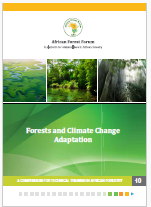
Forests and Climate Change Adaptation A COMPENDIUM FOR TECHNICAL TRAINING IN AFRICAN FORESTRY 10
The Intergovernmental Panel on Climate Change (IPCC) asserts that there is unequivocal evidence that
there have been unprecedented widespread and rapid changes in the atmosphere, ocean, cryosphere
and biosphere over the last four decades, leading to changes in the Earth’s climate. Climate change is a
state of the climate that can be identified by changes in the mean and/or the variability of its properties
and that persists for an extended period, typically decades or longer. Adaptation to the changing climate
and associated variability is key for survival of humans and forest ecosystems. This compendium focuses
on issues related to climate change adaptation in forest and non-forest-based sectors. The document is
divided into four chapters beginning with basic definitions and concepts of adaptation and includes some
case studies from the African continent.
In chapter one several concepts related to climate change and adaptation are explained and discussed
in detail. These include climate change, extreme events, hazards and risks, resilience, vulnerability,
adaptation and maladaptation. Chapter two gives an overview of climate change and climate vulnerability
in development sectors. The relationship between forests and people, forest-based adaptation strategies
and financing and funding opportunities are also discussed. There are several types of adaptation,
varying from those activities done before the climate event to those done after the event. Some are short
term measures while others are long term. The chapter also discusses determinants of adaptation and
characteristics that determine a systen’s ability to adapt. Chapter three discusses importance and types
of assets, resources and capital for adaptation. Chapter four discusses how forest and tree-resources
respond to climate change and climate variability and the interventions of enhancing resilience of forest
ecosystem to cope with impacts of climate change and variability. The chapter also highlights the role
of forests in climate change adaptation, appropriate forest-based initiatives that could help forests and
people to adapt to climate change and forest-based climate change adaptation interventions. The chapter
concludes by assessing the challenges to climate change adaptation and how forest ecosystems services
help vulnerable social systems to adapt. Chapter five introduces learners to adaptation strategies and
related mechanisms from outside the forest sector. These include the significant role to other sectors
such as agriculture, water, health, fisheries and coastal ecosystems, among others. Finally, chapter six
deals with concepts and methods of monitoring, reporting and evaluation of adaptation practices in
forestry, including adaptation measures to climate change in forestry projects. The chapter also includes
methods used for monitoring and evaluation of non-forest-based adaptation options/projects to climate
change and climate variability.
Author(s) list
African Forest Forum (AFF)Country
Subject Area
Publication type
CompendiumRelated publications
View More